Assignment #6
1. Explain why continual quality improvement is important.
Continual Quality improvements is important because its critical for all industries in order to get better and be more productive every day. Perfecting or improving your process will lead to bigger profits with potentially less work. There are several techniques to detect space for improvements, one of the most famous one is Six Sigma. It’s a combination of tests taken in order to detect what processes are slowing or not allowing the whole to be better.
2. What is management’s role in continual quality improvement?
The manager’s role in this whole process is to bring guidance and leadership to their team. It’s very important for the manager to be involved in the everyday tasks because this brings him a better vision on what is really happening. The manager should bring support to the team by communicating and giving clear goals and dates for them to be executed. Also he has to make sure that all their employees or team has the correct tools and resources to efficiently complete the task. Last but not least, continuously monitor the progress to ensure that the schedule is being executed at the desired time while constantly performing some feedback techniques in order to ensure that the work done is correct.
3. Discuss the Kaizen approach
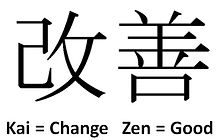
Kaizen is a term created by the Japanese and it’s their philosophy for continuous improvements. KAI means change and ZEN means good and together means change for the good. This philosophy states that big changes come from accumulated small details. In other words, big results happen with the combination of a lot of small improvements together with the goal of big improvements as a whole. Kaizen also promotes cross functional teams to work together or towards the same final goal. Some of their principles are:
-
Good processes bring good results
-
Go see for yourself to grasp the current situation
-
Speak with data, manage by facts
-
Take action to contain and correct root causes of problems
-
Work as a team
-
Kaizen is everybody’s business
4. How would you describe a lean system?
The basic meaning of a lean system is to do more using less. This is a system that detects waste and eliminates it from a process. Waste is most commonly found on overproduction, inventory, transportation & logistics, defects and waiting times. The pioneer of this system s Taiichi Ohno, who developed this method while working for Toyota Motor Company. Its critical for a company that wants to join the movement of lean system to implement the methods to the whole company. Some companies make the error of only implementing lean systems to the departments that most works with engineering. This is a mistake, lean system can be implemented to all departments in a company, including human resources and finance.
5. What is lean six-sigma and how would you apply it to a quality management system?
Six Sigma means that the accepted error rate is only 3.4 units in every million. In an ideal situation, the decried error rate is 0, but everyone knows that it’s a really hard thing to ask. Six Sigma is a group of techniques, tools and steps that helps any industry to lower their error rate to a maximum of 3.4 errors per million. Six Sigma offers a series of certifications that teaches about all of this tools and processes, they are known as the belts. The most basic one is White Belt, which is basically an introduction to Six Sigma. Then you can take the Yellow Belt, which is a class of about 8 hours that goes through all the processes and explains them. The next one is Green Belt, this one teaches more advance tools. The most advanced one is the Black Belt, this one makes you a Six Sigma Professional and allows you to officially be able to teach Six Sigma.
6. Define benchmarking. Define auditing. How does benchmarking and auditing relate to each other?
Benchmarking is comparing your business with the top contenders from your industry. Usually the comparison is based on quality, time and cost. This practice is made to compare yourself with the best on the industry in order to learn from them and see what they are doing that makes them successful. In the other hand, auditing is basically benchmarking yourself in your own company in the financial department. It’s a financial examination of the organization. The idea is to evaluate the financial statements of the organization to make sure the records are an accurate representation of the transactions made.
7. How can you apply benchmarking data in auditing processes, systems, designs, products, factories and services?
Benchmarking can be practiced in every aspect of a company or organization. A lot of organizations have processes, systems, designs, products, factories and services. Like I mentioned earlier, Six Sigma can be applicable to all departments and processes in a company, same thing happens with benchmarking. Benchmarking is the practice of comparing yourself to other companies to look for improvements for your own one and Six Sigma is a great tool to use as a technique to detect those problems.
8. What is a JIT system?
JIT means Just in Time. It’s a method that produced what is needed, for the moment it is needed and with the exact quantity. This method was also created by Toyota motor company and the purpose was to reduce flow time in the production systems and also with the response time from the suppliers and to customers. Now a day, lean manufacturing is the new developed name given to JIT, which includes new strategies and tools with the same intention; to reduce waste.
9. What are the benefits of JIT/lean?
The usage of Just in Time has been proven to be extremely effective in the manufacturing industry. First of all, the company reduces all the inventory costs to the minimum, since they only have in hand what they need at that exact moment. This also brings the benefit of never having overstock, which means money wasted. Also, when having inventory, you have the risk of your stock to become obsolete or out of date. The end of the day, the company finishes with less warehouse costs, better supply chain management and more flexibility to adjust to their customer’s needs.
10. Discuss automation system ideas for JIT/lean
Automation systems and Just in Time/Lean can be a great combination and together they can bring astonishing results in the performance and productivity of a company. The problem comes when adaptation is not well prepared. Lean manufacturing should be implemented first, and after purifying their processes and ensuring maximum quality is already to the limit of human capabilities, then the company can start thinking about automation. The company has to be already great at the human operated process and they should understand how it functions by the detail in order to be able to change it efficiently to an automation system.